Very strong corporate earnings drove the stock market higher in Q3, with the S&P up 2.3% and the MSCI All Country World Index up 1.6%. Tariffs, inflation, and the Iran war create significant investor uncertainty ahead of the midterm elections. In addition, higher bond yields are now the leading topic among investors, as the Federal Reserve raised interest rates to combat persistent inflation, with 10-year Treasury yields increasing more than 80bps this quarter to over 5.25%.
Can the strength of recent corporate earnings overcome the headwind of higher discount rates? Will the economy slow as interest rate sensitive sectors are affected? And what will be the impact of increased gas and diesel prices? Despite these inflationary pressures, consumer spending remains strong, bolstered by resilient labor markets and the “wealth effect” from high stock prices. We will return to the bond market and discuss the potential impact of high yields on the economy later in our review.
Chart 1: Led by Technology, S&P 500 Earnings Growth is Significantly Higher than the Long-Term Average
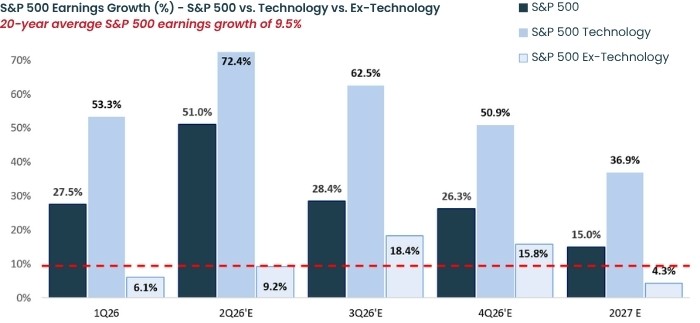
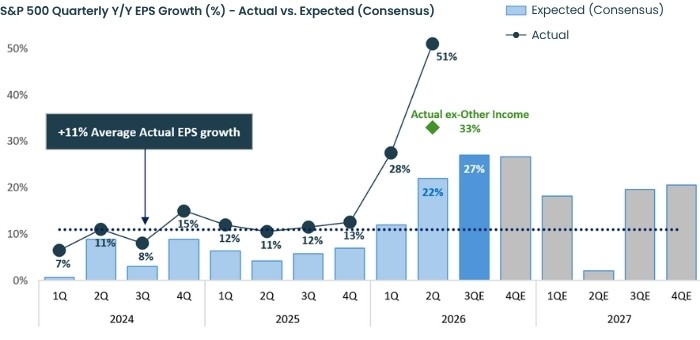
The AI investment surge continues to drive the economy, with technology companies racing to build out AI computing capacity. Corporate earnings continue to exceed expectations, with S&P 500 profits growing over 50% in Q2 and likely to grow above 25% in Q3, driven by technology and energy companies, as well as recent tax cuts and tariff refunds. The much higher growth in earnings from technology firms resulted in the sector outperforming and now accounting for over 50% of the S&P 500 Index. Technology firms now account for a disproportionate share of overall market return, leaving investors to assess what the upper limit of this market concentration might be.
Chart 2: Earnings are High and, Importantly, Continue to Exceed Market Expectations
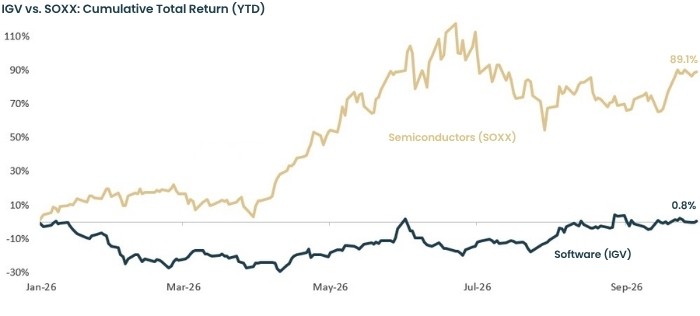
Despite the overall strong performance of technology stocks, we see a bifurcation of returns within the sector. Semiconductor stocks (defined by the Semiconductor Index (SOXX)) are soaring with demand outpacing supply, while software companies (defined by the Software Index (IGV)) have declined as investors worry that AI will replace or reduce the profitability of software companies.
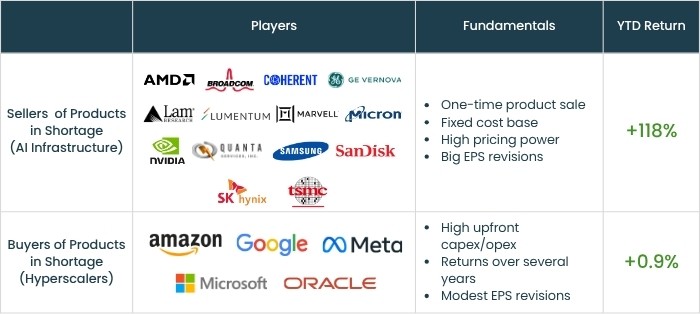
We are watching AI adoption and disruption trends closely. Hyperscalers are collectively spending $750 billion in capital expenditures this year, and 2027 spending estimates increased to over $1.0 trillion. This massive spending surge has led to less free cash flow and increased reliance on debt and off-balance-sheet financing. Thus, investors increasingly worry about the unknown timing and future return potential of these large investments. Meanwhile, as beneficiaries of this massive AI capital program, semiconductor and AI infrastructure companies are seeing record revenues, earnings and free cash flow.
Charts 3 and 4: Semiconductors (SOXX) and AI Infrastructure Benefit from Hyperscaler Spending and Post Exceptional Returns, While Software (IGV) Struggles
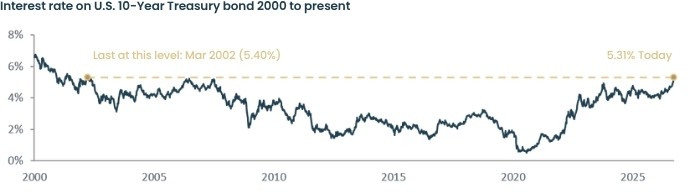
The biggest event this quarter was the rise in the US Treasury 10-year bond yield to the highest level since 2002. With the current federal debt at 123% of GDP (twice the 2002 debt level of 55.2% of GDP) the interest expense burden is more than twice as high today and exceeds military spending as a percent of government spending. We hope this increased supply of Treasury debt will find adequate investor demand at reasonable yields.
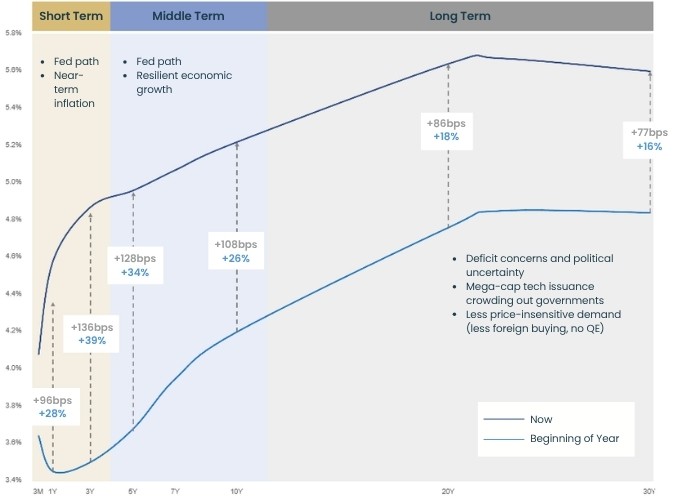
Higher interest rates will inevitably affect economic activity. We worry that government deficits and the FED’s struggle with sticky inflation may have become structural problems, and we worry that interest rates may not return to pre-Covid levels below 2%. Interest rates have moved up across the “curve.” Short-term rates are responding to more hawkish FED policy and concerns on near-term inflation. Longer term rates are affected by 1) a huge supply of new debt from large fiscal deficits across the developed world and significant new issuance from large tech firms, as well as 2) increased concerns around FED independence and the ultimate impact of the large and rapidly growing debt burden.
Charts 5 and 6: Various Drivers Have Pushed U.S. Interest Rates to Multi-Decade Highs
Future market performance may hinge on the pace and utility of AI adoption across the broader economy. Will real productivity enhancements flow through to consumers and corporations? Will rising interest rates slow economic growth and affordability next year? Will employment and household spending remain resilient? These are key long term questions as those at the top of the wealth ladder reap most of the benefits of owning equities.
When the market moves upward, it typically advances in a crooked line. Current earnings trends are strong, but a persistent rise in corporate and Treasury bond yields will make investors nervous about debt leverage and repayment risk, and less patient about a delayed payoff from the AI investment boom. Higher yields make servicing debt more expensive for companies and governments alike.
The quickening pace of change in government policy is shifting our nation’s strategic alliances, trading partners, and consumer confidence ahead of the midterm elections. AI deployment is happening faster than other prior disruptive technologies, and this implementation speed poses unknown risks to the economy and society, since we do not yet have the regulatory infrastructure to safeguard its proper usage. We caution that the mechanics of government oversight are also changing, as the Trump administration has claimed more decision power over the Federal government. Investor confidence depends on the ability of the AI industry and government to quickly establish oversight standards. The road ahead may be bumpy even if the economy benefits in the long run from this latest technology revolution.
We look forward to hearing from you and providing updates on your portfolio and our outlook for the rest of the year. Please reach out with any questions.
Best regards,
The Choate Wealth Investment Team